Melmoth’s return to the flock
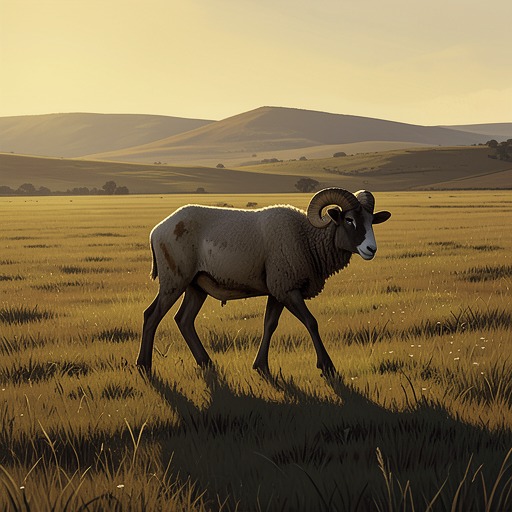
Three Bags FullMelmoth’s return to the flock transforms a cautionary legend into a living presence—and, through his account of the fifth night, gives the sheep a crucial clue about George Glenn’s death and departure. The gray ram whom lambs had been taught to fear reappears as Sir Ritchfield’s identical twin: at once a homecoming, a challenge to the flock’s stories, and a witness to the night George died.
The return of a supposed ghost
Melmoth’s reappearance throws the flock into uproar. He was not merely a ram who had gone missing. His absence had become a warning passed from older sheep to younger ones: he had leaned too close to the abyss and never come back; he had eaten strange fodder and died. Mothers had used his supposed fate to keep lambs obedient, and the Winter Lamb, who had heard more Melmoth horror stories than anyone, now faces the living ram himself. The return exposes how the flock had made a cautionary figure out of someone whose fate it did not know.
The confusion deepens because Melmoth looks exactly like Sir Ritchfield. Heather sees two versions of the same ram, while Miss Maple identifies the newcomer as Melmoth. To the flock, he is both familiar and impossible: the vanished sheep has returned in the likeness of its lead ram. Some call him the one who got away scot-free, with uncertainty over whether the phrase is an insult or a tribute. Once Ritchfield explains why no sheep may graze on George’s Place, however, Melmoth is initially received with friendliness. The return does not simply restore an old member; it forces the flock to decide how the returned outsider belongs.
A twin changes places
The resemblance makes leadership a practical problem. The sheep would prefer to keep Sir Ritchfield as lead ram, but they cannot reliably distinguish him from Melmoth. Meanwhile, Ritchfield himself has changed: he is more cheerful and playful, almost as daring as a young ram, and no longer seems interested in leading. He spends much of his time close to Melmoth, and the flock has never seen him so happy. Their reunion is therefore not just a matter of mistaken identity. It changes Ritchfield’s bearing and unsettles the role the flock had expected him to continue filling.
Ritchfield answers the return with a rule that reshapes the meaning of Melmoth’s disappearance: no sheep may leave the flock unless that sheep comes back again. The exception makes return part of the rule rather than proof that the rule has failed. Melmoth’s presence gives the flock a living example of departure followed by re-entry, while Ritchfield’s response makes room for that history without abandoning the flock’s concern about sheep going missing.
The story of the fifth night
Melmoth turns his return into a telling. He invites the flock to hear the story of the fifth night, and the sheep gather beneath the shade tree, where he rests on old leaves. Even the Winter Lamb watches from behind the trunk. Though the day is hot and still, Melmoth’s storytelling makes the flock shiver and race through darkness with him. His tale reaches them not only as words but as an experience that seems to carry the cold and fear of the night into the summer meadow.
The story also connects Melmoth’s long absence to George. When Miss Maple asks how he knows George is dead, Melmoth explains that the signs were impossible to miss: the blue-eyed man had brought his pale-eyed flock, the sheep had plundered the vegetable garden, and people were trampling the grass. More directly, he had seen George’s body at night. Melmoth found him before the carrion beetles, while some warmth of life remained. He walked around the body three times in each direction, leapt three times, and put a hoof on George’s heart. He had hoped George might see him once more and know he had made it back, but he arrived one sunset too late.
That account explains the hoofprint on George’s body. Miss Maple recognizes Melmoth as the apparent wolf’s ghost: the shaggy shape, glowing eyes, fluid movement, and crows on his back had made the returning ram seem supernatural. What the sheep had treated as a ghostly trace is instead evidence of Melmoth’s presence beside George. His return thus supplies a witness to the body without identifying who drove the spade into it.
Departure, return, and the flock’s history
After Melmoth disappears into the gorse hedge, the meadow seems strangely empty. Ritchfield insists that Melmoth has only gone for a stroll and will return, repeating the new rule as reassurance. The moment echoes the earlier disappearance but does not resolve it into permanent loss: the flock is left waiting, with Ritchfield’s confidence standing against the old legend of a sheep who never came back.
Miss Maple draws a further conclusion from Melmoth’s story. On the night he recounts, George discovered that his was the wrong flock because it had killed Weasel McCarthy. In her comparison, the horror was like living among sheep and discovering that the others were wolves. Melmoth’s return does not solve George’s murder, but it changes how the flock understands George’s own departure and the hoofprint at the scene. The legend of the missing ram becomes a route into the flock’s buried history: a return that restores one sheep while bringing the truth about another’s isolation closer to view.